

Our Carbon Reduction Plan
Committed to Net Zero by 2050
Smartcool is a global clean technology company helping some of the world's largest organisations enhance their profitability while lowering their carbon footprint. Practising what we preach, we have formally measured our own greenhouse gas emissions and published a structured pathway to Net Zero by 2050, in line with the UK's national commitment and the GHG Protocol Corporate Standard.
66.71 tCO₂e
Total baseline carbon footprint (Scope 1, 2 and 3, 2025 baseline year)
60%
Of our emissions come from fleet operations. Our primary reduction target
Zero
Scope 2 electricity emissions: we run on a verified zero-carbon Octopus Energy tariff
2050
Our commitment date for achieving absolute Net Zero

Walking the Talk
As a clean technology company, our credibility depends on holding ourselves to the same standard we set for our clients. We help commercial and industrial organisations reduce energy consumption and carbon emissions at sites across the world. This Carbon Reduction Plan commits us to doing the same.
Our approach follows a "reduction-first" methodology: we prioritise the absolute reduction of operational emissions before addressing residual impacts through verified removal mechanisms. This is not about greenwashing. It is about measurable, evidence-based progress.
The plan covers our full greenhouse gas inventory across UK operations, addressing Scope 1 (direct emissions from our fleet), Scope 2 (electricity), and the mandated subset of Scope 3 emissions as defined by PPN 006 and the GHG Protocol Corporate Standard. It has been reviewed and signed by our Managing Director, and will be formally updated each year.
Where Our Emissions Come From
Our baseline footprint of 66.71 tCO₂e is concentrated in a small number of sources, which makes our reduction roadmap clear and actionable.
Fleet operations are the dominant factor. Our installation and service fleet accounts for 60% of total emissions through Scope 1 mobile combustion, with a further 14.5% attributable to the associated fuel supply chain (Scope 3, Category 3). Together, these represent over 74% of our total carbon footprint and define our primary decarbonisation lever.
Business travel, including international flights and reimbursed mileage for regional site visits, contributes 20.6% of our footprint. The remaining categories, including employee commuting, waste generation, and upstream transport, account for under 5% combined.
One figure we are particularly proud of: our Scope 2 electricity emissions are zero. Our office operates on a verified zero-carbon renewable energy tariff through Octopus Energy. Our public vehicle charging sessions are similarly zero-carbon. This reflects a deliberate energy procurement decision and mirrors the energy intelligence principles we deliver to our clients.
Our Pathway to Net Zero
Immediate and Short-Term Actions
Our near-term focus is on reducing emissions from the existing internal combustion engine fleet, using a combination of technical and behavioural interventions modelled by BCR Associates:
Speed limiting at 60mph for the full van fleet, based on independent industry data showing a 17.5% fuel economy improvement versus 70mph for light commercial vehicles, is projected to reduce Scope 1 emissions by 8.67 tCO₂e under a realistic scenario. This is a hardware-enforced measure with immediate, permanent effect.
Annual driver training, reinforcing efficient driving behaviours, is modelled to deliver a cumulative reduction of 18.7 tCO₂e over five years. The modelling demonstrates that annual refreshment is critical: without it, a 2.5% yearly decay rate significantly erodes initial gains.
Tyre pressure monitoring systems (TPMS) provide a further 0.74 tCO₂e annual saving through improved fuel efficiency across the fleet.
For business travel, an EV salary sacrifice scheme will address grey fleet emissions from personal vehicles used for business mileage. This is modelled to reduce targeted road travel emissions by 79%, from 4.74 tCO₂e to 0.99 tCO₂e, by transitioning from fossil fuels to battery electric vehicles.
Long-Term Decarbonisation
The long-term strategy is clear. Full electrification of our van fleet is the essential pathway to eliminating Scope 1 emissions entirely and represents the primary lever in our Net Zero trajectory.
The 2050 horizon provides a measured, capital-efficient window to align vehicle replacement cycles with the continued expansion of the UK's national charging network and advances in EV range and payload capacity for field service operations.
We are also committed to minimising carbon-intensive travel. Domestic journeys will prioritise rail over air, and virtual collaboration tools will reduce flight frequency where client service quality is not affected.
Following the mitigation of these primary emission sources, a small residual footprint of approximately 3.3 tCO₂e will be addressed through verified, high-quality carbon offsetting in the final phase of our journey.
Download Our Documents
Our full Carbon Reduction Plan and Net Zero Commitment Statement are published below in compliance with PPN 006 requirements. Both documents are freely available to download and share.
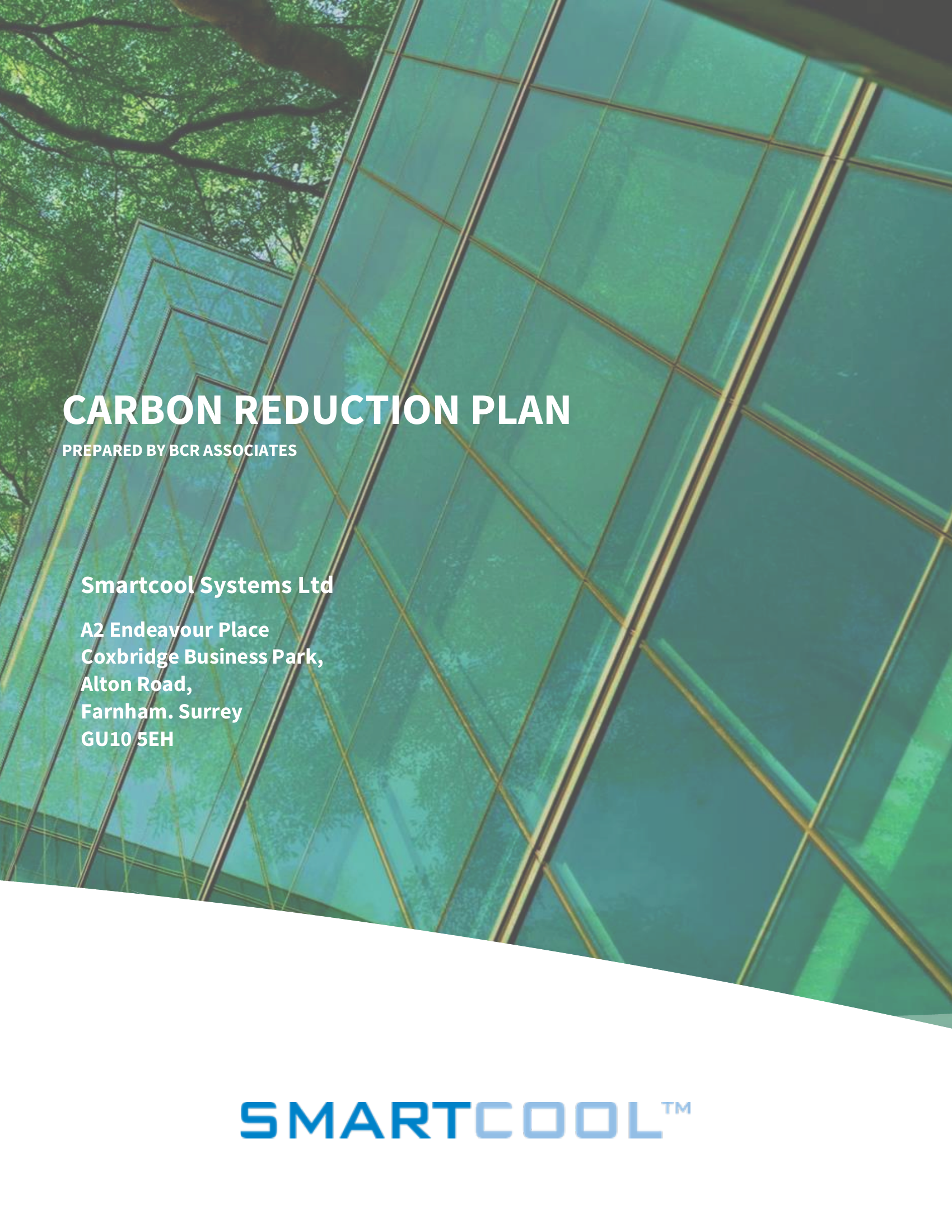
Document label: Smartcool Systems Carbon Reduction Plan 2026
Prepared by: BCR Associates
Published: May 2026
Standard: GHG Protocol Corporate Standard, PPN 006
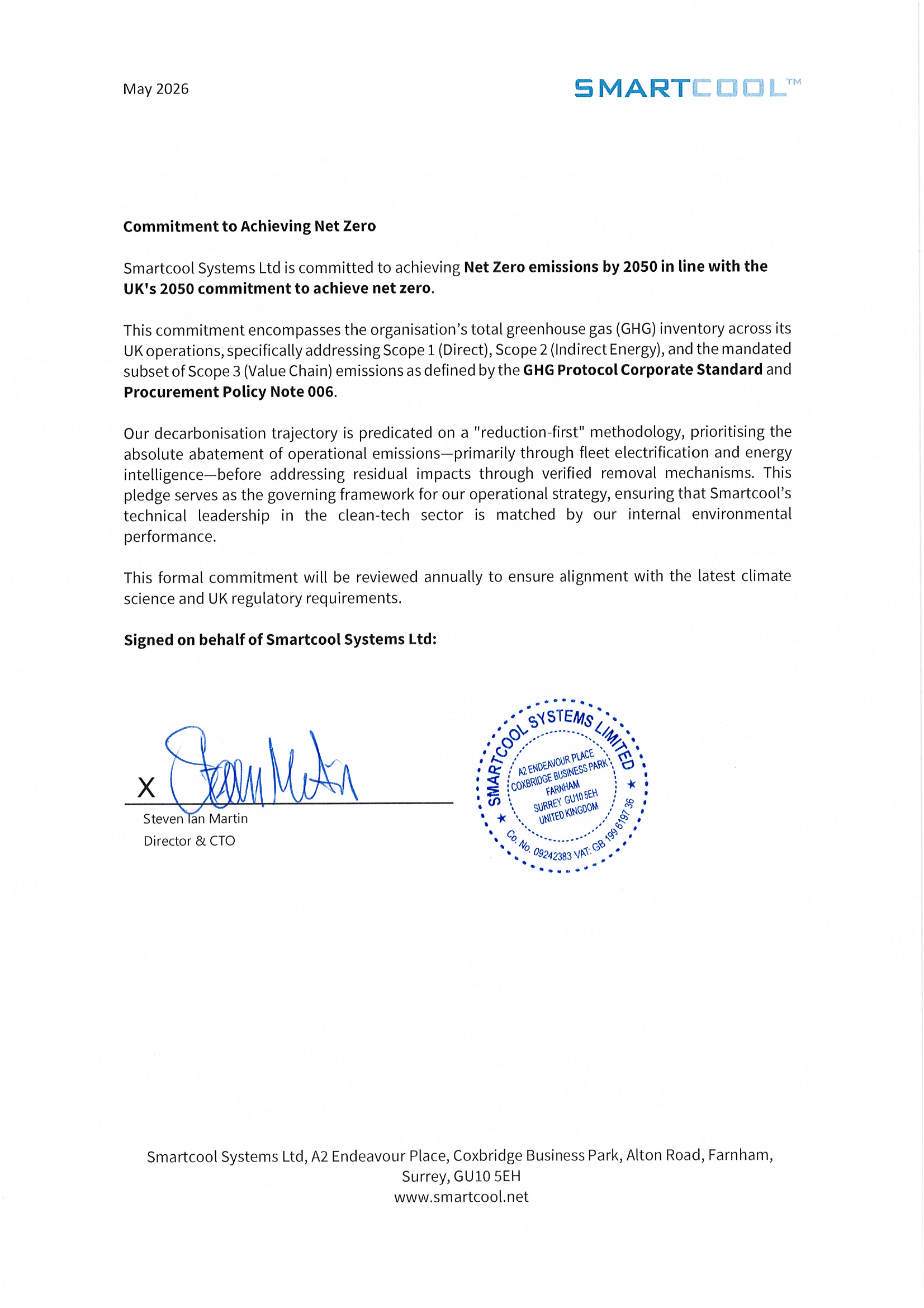
Document label: Smartcool Net Zero Commitment Statement
Signed by: Steven Ian Martin, Director and CTO
Published: May 2026
This Carbon Reduction Plan was prepared by BCR Associates in accordance with the GHG Protocol Corporate Standard and Procurement Policy Note 006 (PPN 006). It covers Smartcool Systems Ltd's UK operations and will be reviewed and updated annually. Questions about this plan can be directed to our contact form.
Smartcool Systems Ltd, A2 Endeavour Place, Coxbridge Business Park, Alton Road, Farnham, Surrey, GU10 5EH. Company No. 08242383.